

Joystiq
Joystiq News
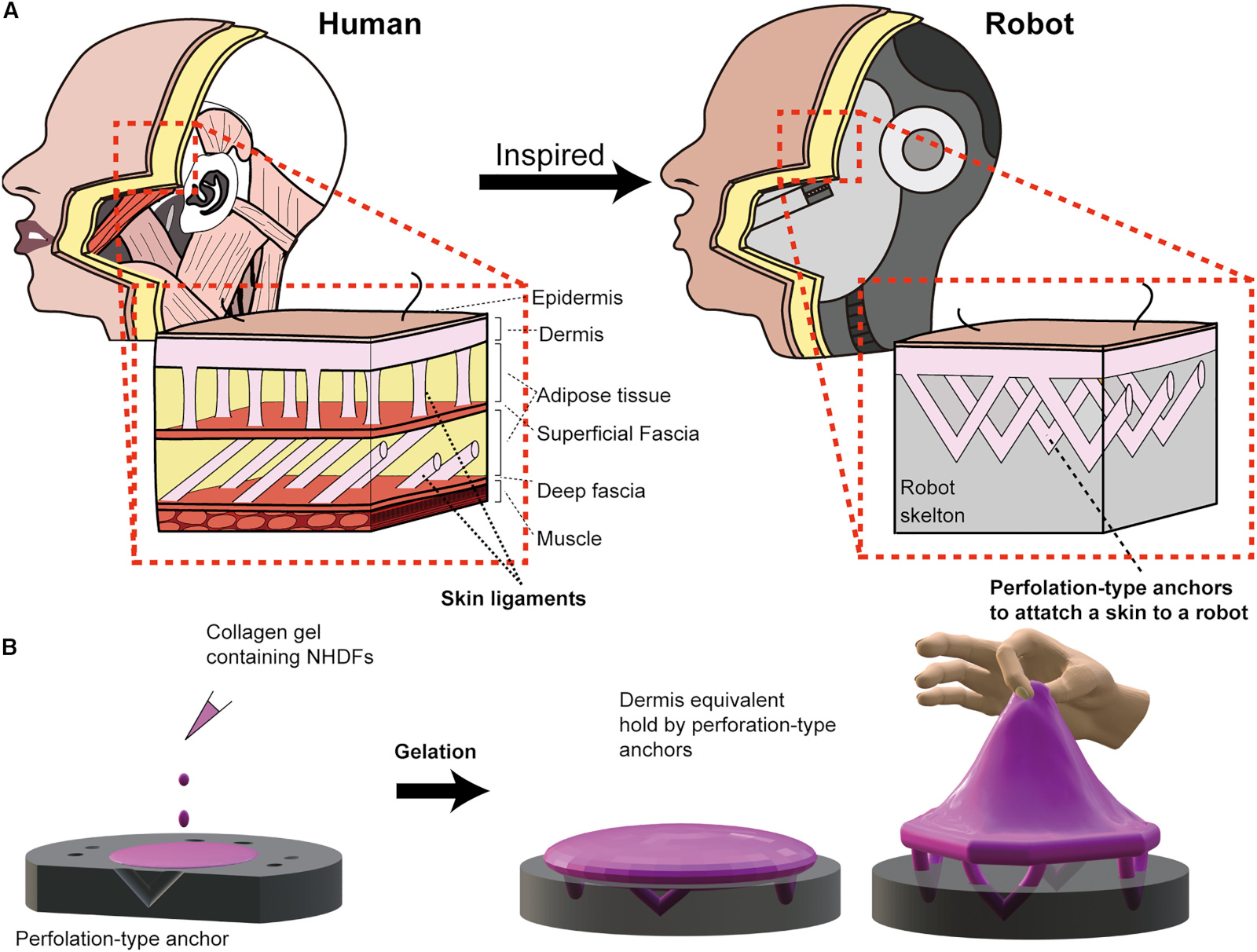
Someday, we may have so real, they have skin that looks and feels, heals and moves just like ours. A team of scientists from the University of Tokyo and Harvard University are looking into how to make that happen, and the process includes creating some pretty curious, partly terrifying and partly adorable experimental machines with skin. In their paper published in (via ), the researchers explained that current molding techniques used to create skin equivalents that can fit 3D structures like robotic fingers perfectly do not have a mechanism that can "fix the skin to the underlying subcutaneous layer." For their study, they used a technique they're calling "perforation-type anchors," which is inspired by skin ligaments, as a solution to that problem.
University of Tokyo
Simply put, skin ligaments keep our skin attached to the tissue and muscle underneath, so it doesn't get loose and go all over the place like fabric on a mannequin whenever we move. The team intends for its perforation-type anchors to take the place of those ligaments in machines. To demonstrate the method's effectiveness in attaching synthetic skin to a "3D objects with intricate contours," the researchers molded fabricated skin equivalent onto a fake head.
They also created a robotic face covered with a dermis equivalent that can smile. When the machine produces a "sliding motion" to mimic the movement of our face when we smile, the fabricated skin deforms to create a smiling expression. While the result could come across as creepy for some, we think the cute pink blob looks like the after it's been thoroughly moisturized, or a very ruddy and shiny Thomas the Tank Engine.

University of Tokyo
This article originally appeared on Engadget at
Console Bang News!
University of Tokyo
Simply put, skin ligaments keep our skin attached to the tissue and muscle underneath, so it doesn't get loose and go all over the place like fabric on a mannequin whenever we move. The team intends for its perforation-type anchors to take the place of those ligaments in machines. To demonstrate the method's effectiveness in attaching synthetic skin to a "3D objects with intricate contours," the researchers molded fabricated skin equivalent onto a fake head.
They also created a robotic face covered with a dermis equivalent that can smile. When the machine produces a "sliding motion" to mimic the movement of our face when we smile, the fabricated skin deforms to create a smiling expression. While the result could come across as creepy for some, we think the cute pink blob looks like the after it's been thoroughly moisturized, or a very ruddy and shiny Thomas the Tank Engine.
University of Tokyo
This article originally appeared on Engadget at
Console Bang News!