

Joystiq
Joystiq News
Toyota Monday it plans to expand its European lineup of battery electric vehicles (BEVs) to six models by 2026. The automaker revealed two new concepts for its upcoming EV fleet, including a “close-to-production” Urban SUV and a Sport Crossover scheduled for a 2025 European launch. Toyota, which Reuters is the world’s largest automaker by sales, currently sells only one fully electric model, the . It aims for 100 percent carbon neutrality by 2035.
The company’s two newly revealed concepts will join the bZ4X and a Compact SUV it last year. Toyota’s new Urban SUV concept is slated for a European launch in 2024. Its “authentic SUV design” draws inspiration from the company’s , a top seller in its class. The Urban SUV concept will come in front-wheel and all-wheel-drive options and two battery tiers — a budget one and another with a longer range.
Meanwhile, Toyota had less to say about its Sport Crossover concept. We know it has a sloping profile, which the company will use to position it as a sleeker alternative to traditional SUVs. The automaker expects that concept to enter production in 2025.
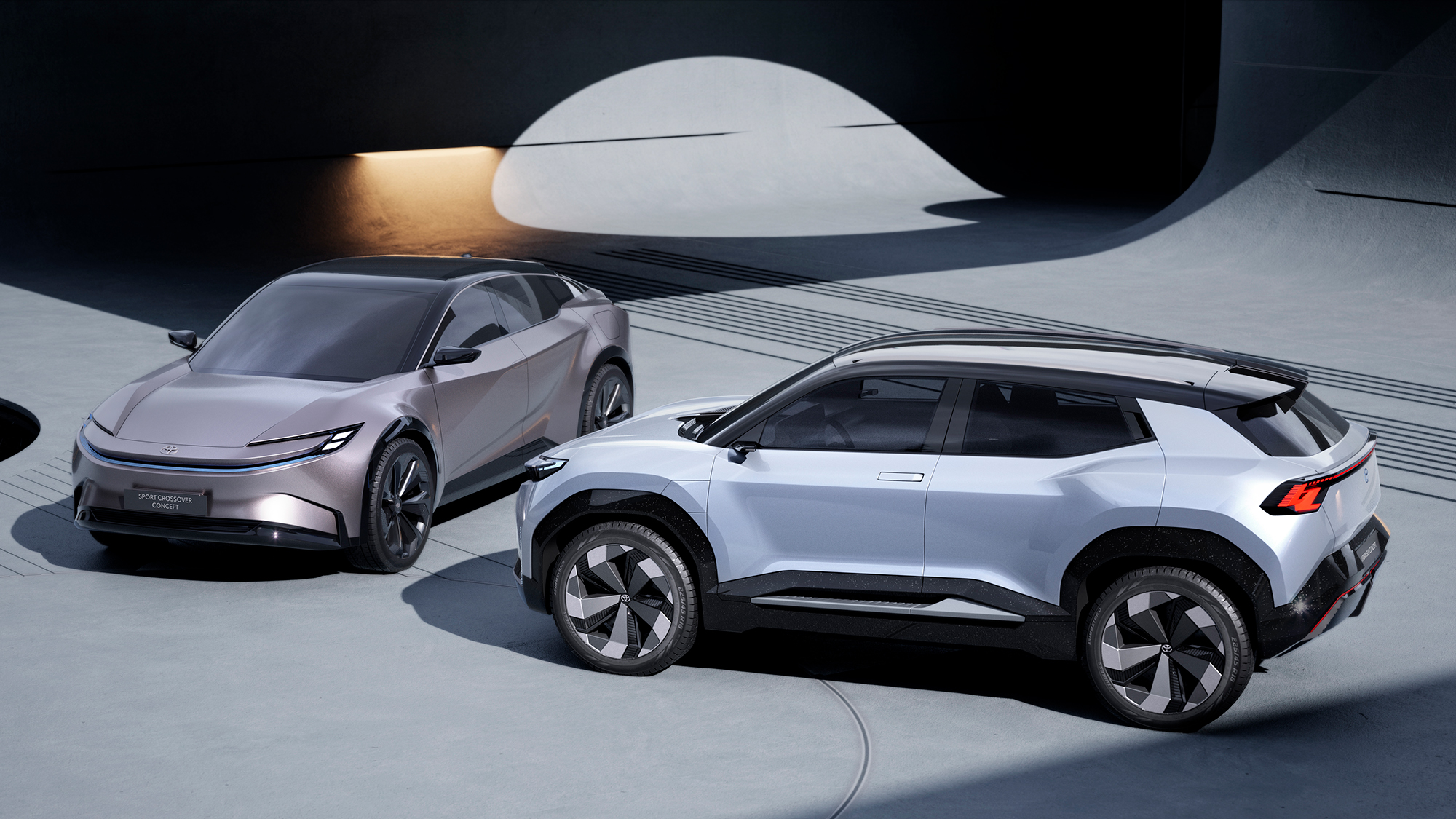
Toyota’s Sport Crossover (left) and Urban SUV concepts.
Toyota
Toyota plans to launch next-generation batteries in 2026 and beyond. The first will focus on performance, offering a conventional structure with double the range and a 20 percent cheaper price tag than the bZ4X.
A second battery will be a “good quality, low-cost” one designed to spur . It will have a “new shape” with a bipolar structure, primarily using cheaper (LFP). With this cell, Toyota aims for a 20 percent higher range and 40 percent lower cost than the bZ4X.
A third battery will be strictly high-performance, using high nickel cathode and bipolar technologies. “Even lower costs and a further extended driving range are expected” was all Toyota said about that battery’s range and pricing goals.
Finally, Toyota teased progress with its first , which may still be three or four years away. “We have made a technological breakthrough that overcomes the long-standing challenge of solid state battery durability,” said Andrea Carlucci, vice president of Toyota Europe, in a press release. “A method for mass production is currently being developed and we are striving for commercialisation in 2027-2028 with production capacity of several tens of thousands of vehicles.” With its solid-state cells, the automaker’s goal is a charging time of 10 to 80 percent in only 10 minutes.
This article originally appeared on Engadget at
Console Bang News!
The company’s two newly revealed concepts will join the bZ4X and a Compact SUV it last year. Toyota’s new Urban SUV concept is slated for a European launch in 2024. Its “authentic SUV design” draws inspiration from the company’s , a top seller in its class. The Urban SUV concept will come in front-wheel and all-wheel-drive options and two battery tiers — a budget one and another with a longer range.
Meanwhile, Toyota had less to say about its Sport Crossover concept. We know it has a sloping profile, which the company will use to position it as a sleeker alternative to traditional SUVs. The automaker expects that concept to enter production in 2025.
Toyota’s Sport Crossover (left) and Urban SUV concepts.
Toyota
Toyota plans to launch next-generation batteries in 2026 and beyond. The first will focus on performance, offering a conventional structure with double the range and a 20 percent cheaper price tag than the bZ4X.
A second battery will be a “good quality, low-cost” one designed to spur . It will have a “new shape” with a bipolar structure, primarily using cheaper (LFP). With this cell, Toyota aims for a 20 percent higher range and 40 percent lower cost than the bZ4X.
A third battery will be strictly high-performance, using high nickel cathode and bipolar technologies. “Even lower costs and a further extended driving range are expected” was all Toyota said about that battery’s range and pricing goals.
Finally, Toyota teased progress with its first , which may still be three or four years away. “We have made a technological breakthrough that overcomes the long-standing challenge of solid state battery durability,” said Andrea Carlucci, vice president of Toyota Europe, in a press release. “A method for mass production is currently being developed and we are striving for commercialisation in 2027-2028 with production capacity of several tens of thousands of vehicles.” With its solid-state cells, the automaker’s goal is a charging time of 10 to 80 percent in only 10 minutes.
This article originally appeared on Engadget at
Console Bang News!